


Welcome, Sandbox friends.
Today’s Daily discusses:
bull markets climb a wall of worry
Let’s dig in.
Blake
Markets in review
EQUITIES: Nasdaq 100 -0.21% | S&P 500 -0.41% | Russell 2000 -0.60% | Dow -1.13%
FIXED INCOME: Barclays Agg Bond -0.31% | High Yield -0.32% | 2yr UST 3.946% | 10yr UST 4.432%
COMMODITIES: Brent Crude -0.06% to $113.94/barrel. Gold -0.06% to $4,531.3/oz.
BITCOIN: +2.09% to $80,305
US DOLLAR INDEX: +0.33% to 98.48
CBOE TOTAL PUT/CALL RATIO: 0.76
VIX: +7.65% to 18.29
Quote of the day
“Discipline is choosing between what you want now and what you want most.”
- Abraham Lincoln
Bull markets climb a wall of worry
It has now been more than three-and-a-half years since the bull market began in October 2022.
At that time, inflation was rising at its fastest pace in fifty years, the Fed was aggressively hiking interest rates, and ChatGPT was still a month away from being released to the public.
Since then, the S&P 500 has more than doubled in value, while the Bloomberg U.S. Aggregate Bond index has recovered from its vicious 18% drawdown.
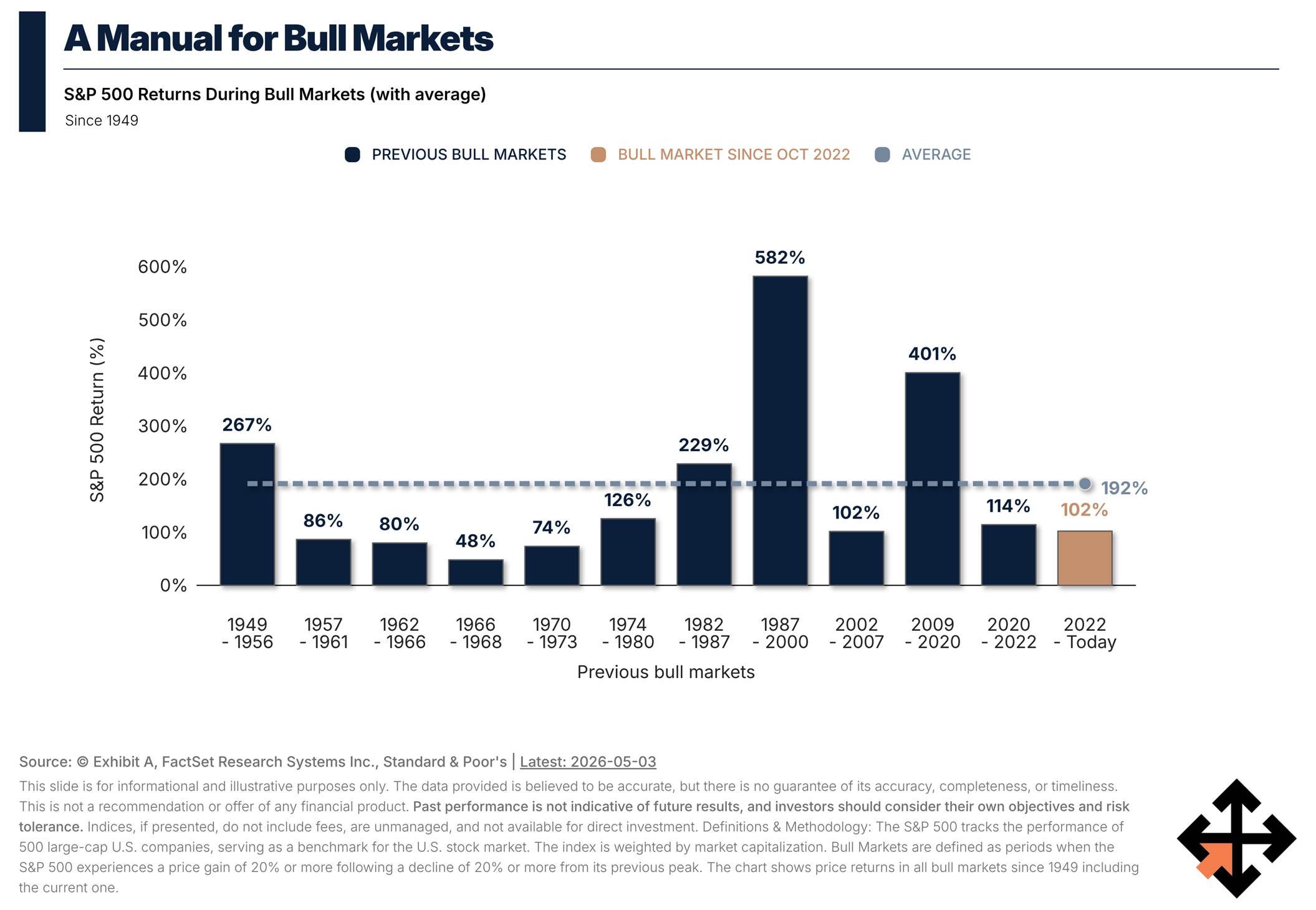
Although the world has changed since quite a bit, the fact that there are market concerns in the headlines has not.
Each cycle brings new challenges and questions about whether the tried-and-true rules of investing are still relevant.
The reality is that each cycle is unique, with catalysts, innovations, and sources of uncertainty that are never quite the same. And yet, the underlying principles of investing and financial planning have remained consistent across decades, and have continued to point investors in the right direction this year.
Even though geopolitics continue to impact markets, perhaps the more important consideration for long-term investors is the overall market cycle.
With the market hovering near all-time highs, it’s natural for some investors to worry about market pullbacks and corrections. After all, these events can occur frequently, with the S&P 500 historically experiencing 3 to 4 pullbacks of 5% each year, on average.
While they are never pleasant, long-term investing depends much more on historical patterns over years and decades. This is one reason that overreacting to market swings can be counterproductive, since it may leave investors poorly positioned in the context of their long-term financial goals.
Investors often say that the market climbs a “wall of worry” on a regular basis.
Over the past several years, markets have overcome higher prices across the board, a banking crisis in 2023, multiple geopolitical conflicts spanning the globe, the possibility of a Fed policy error, AI-related market concentration, tariff-driven volatility, and much more. None of these concerns are trivial and yet, through all of them, the market has performed well.
The chart below helps to illustrate this pattern starting from World War II.
Over this 70-year period, bull markets have lasted far longer and generated larger gains than what’s lost in bear markets.
Specifically, bear markets have typically lasted 1-2 years on average, whereas recent bull markets have run as long as 10 years or longer. Even when market corrections occur during bull markets, the average decline is 14%, with the average recovery requiring just 4 months.
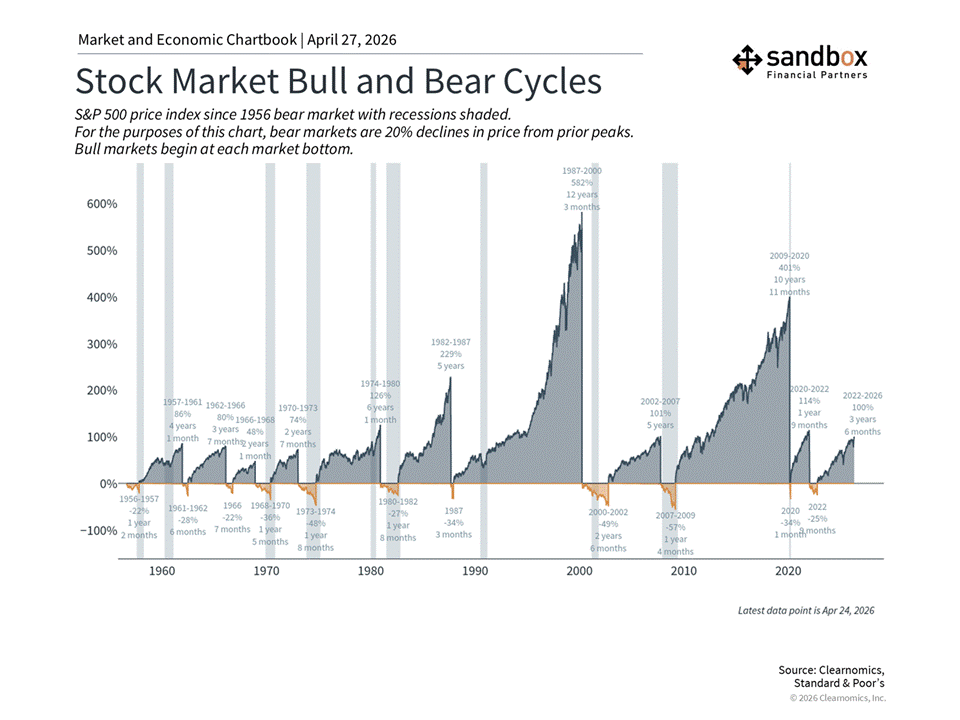
For instance, the bull market cycle that followed the 2008 Global Financial Crisis lasted nearly 11 years. Despite this, it is often referred to as “the most unloved bull market” since there was a constant stream of market and economic concerns.
In hindsight, it’s easy to see that even when these concerns were legitimate, such as around the state of the economic recovery or the size of the national debt, they didn’t justify changes to long-term portfolios.
Of course, the past is no guarantee of future results, and how quickly markets rebound depends on the specific circumstances. But the historical record makes it clear that trying to react to every market move has, more often than not, caused investors to miss much of the gains that eventually followed.
Sources: Exhibit A, Clearnomics
That’s all for today.
Blake
Questions about your financial goals or future?
Connect with a Sandbox financial advisor – our team is here to support you every step of the way!
Welcome to The Sandbox Daily, a daily curation of relevant research at the intersection of markets, economics, and lifestyle. We are committed to delivering high-quality and timely content to help investors make sense of capital markets.
Blake Millard is the Director of Investments at Sandbox Financial Partners, a Registered Investment Advisor. All opinions expressed here are solely his opinion and do not express or reflect the opinion of Sandbox Financial Partners. This Substack channel is for informational purposes only and should not be construed as investment advice. The information and opinions provided within should not be taken as specific advice on the merits of any investment decision by the reader. Investors should conduct their own due diligence regarding the prospects of any security discussed herein based on such investors’ own review of publicly available information. Clients of Sandbox Financial Partners may maintain positions in the markets, indexes, corporations, and/or securities discussed within The Sandbox Daily. Any projections, market outlooks, or estimates stated here are forward looking statements and are inherently unreliable; they are based upon certain assumptions and should not be construed to be indicative of the actual events that will occur.
Please see additional disclosures (click here)
Please see our SEC Registered firm brochure (click here)
Please see our SEC Registered Form CRS (click here)