


Welcome, Sandbox friends.
Today’s Daily discusses:
Ben Affleck and Matt Damon keep delivering the goods
Let’s dig in.
Blake
Markets in review
EQUITIES: Nasdaq 100 +0.76% | Russell 2000 +0.76% | Dow +0.63% | S&P 500 +0.55%
FIXED INCOME: Barclays Agg Bond +0.02% | High Yield +0.07% | 2yr UST 3.612% | 10yr UST 4.249%
COMMODITIES: Brent Crude -1.49% to $64.24/barrel. Gold +1.83% to $4,925.9/oz.
BITCOIN: -0.86% to $89,187
US DOLLAR INDEX: -0.48% to 98.283
CBOE TOTAL PUT/CALL RATIO: 0.85
VIX: -7.46% to 15.64
Quote of the day
“I’ve been waking up every night thinking about time. How much has passed and how much I got left. Thinking what the fuck am I gonna do with it.”
- Lieutenant Dane Dumars (Matt Damon) in The Rip
The economics of attention are rewriting everything
Today’s post is a departure from our normally scheduled programming but for good reason:
We have to discuss The Rip.
And no, this is not a movie review.
After watching The Rip – the new Netflix crime-thriller starring Matt Damon and Ben Affleck as Miami narcotics officers – and then going down the rabbit hole with their Joe Rogan Experience appearance promoting it, I felt compelled to explore a few ideas that jumped out to me.
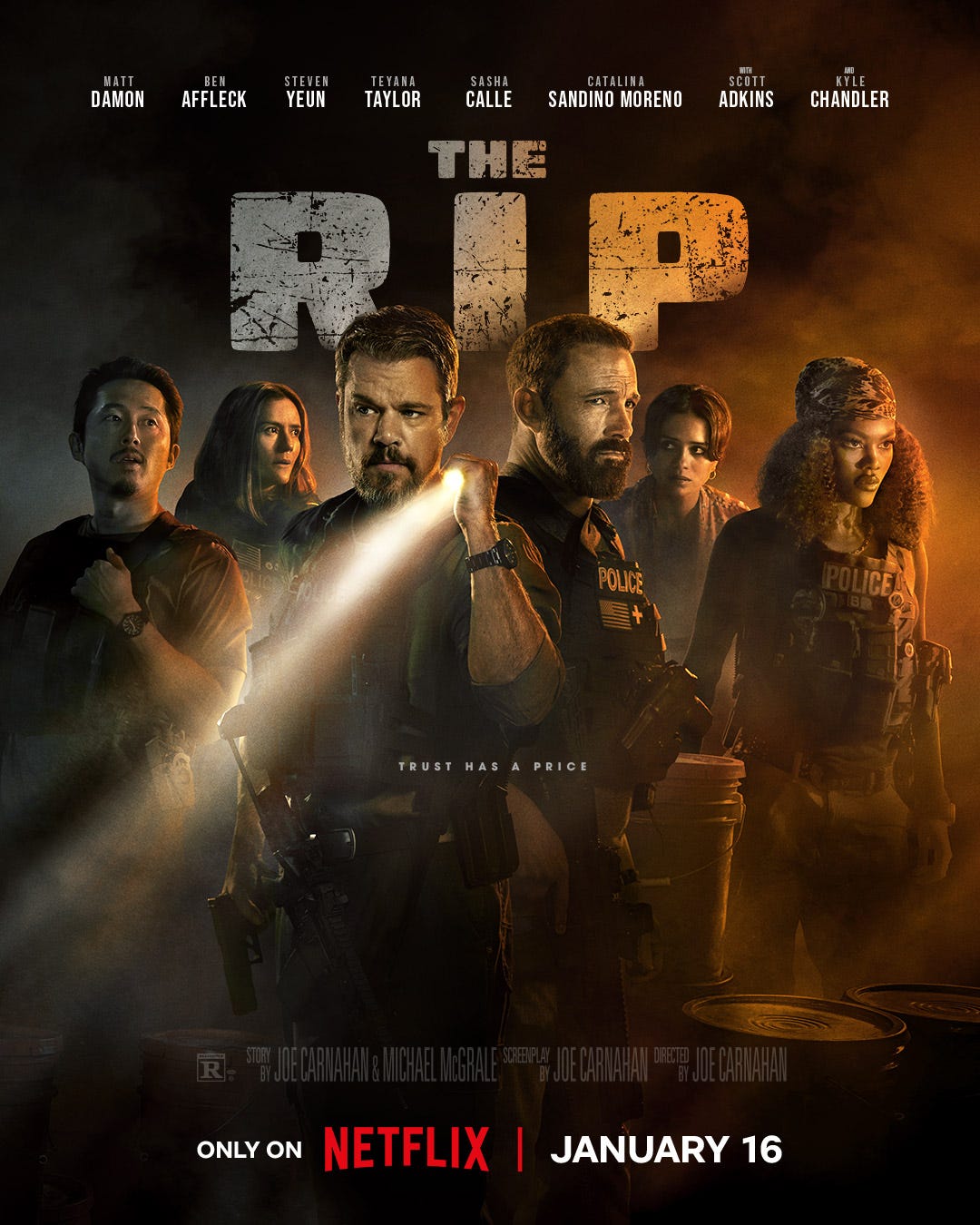
Matt Damon sheds light on how Netflix is now asking filmmakers to restate the plot multiple times in the dialogue throughout a movie because viewers are likely:
1) watching on their phones while scrolling and clicking into drop down notifications or
2) sitting on their couch at home and are whisked away 5-6 times from their flatscreen to deal with a physical distraction.
Damon also mentions that studios have shifted big action set pieces into the first 5-15 minutes of the film, just to hook people before they inevitably drift away.
Make no mistake: these aren’t creative complaints.
These are behavioral observations. Shifts in traditional storytelling arcs. Acknowledgement of the attention economy.
Creators now must earn attention before they earn trust.
In other words, the economics of our attention now steer creative decisions.
Later, Ben Affleck drops a heater on the AI boom and its place across film, society, and the economy that was refreshingly grounded and honest:
1) adoption is slow
2) progress is incremental and
3) new technologies are often overhyped by people trying to justify their valuations
Affleck’s bottom line point?
AI isn’t going to replace everyone and everything overnight, so everyone needs to relax.
I believe Ben’s point is valid here.
AI is a tool. A powerful one, yes – but still just a tool in the tool shed. A complementary piece, not the only piece.
That framing matters, because it runs counter to the commonly placed narrative we all hear – the one where robots and artificial intelligence replace humans in the world order and Skynet becomes a documentary rather than a James Cameron trilogy.
It also contrasts sharply with the other tools dominating our attention: social media feeds, gambling apps, zero-friction trading platforms. Those aren’t designed to help us think better or create more. They’re designed to keep us engaged, clicking, and reacting.
If movies now have to repeat their own plot because audiences can’t stay locked in and redraw the map of their big action sequences into a hook, it raises an uncomfortable question:
What else is being reshaped by our distractions?
Affleck and Damon aren’t whining about “kids these days.”
They’re adapting, and it’s truly a beautiful thing to see, especially since I’ve been watching their films for 30+ years.
Affleck and Damon are trying to tell thoughtful stories in a world optimized for immediacy. And they’re doing it without pretending the past is coming back.
That’s what made the Joe Rogan podcast so compelling. Two old-school actors, deeply fluent in the new playbook – embracing reality without surrendering to it.
If this is what movies have to do today, it’s worth asking how many other parts of our culture are quietly being rewritten.
Not because we’re dumber, but because we’re less present.
That’s all for today.
Blake
Questions about your financial goals or future?
Connect with a Sandbox financial advisor – our team is here to support you every step of the way!
Welcome to The Sandbox Daily, a daily curation of relevant research at the intersection of markets, economics, and lifestyle. We are committed to delivering high-quality and timely content to help investors make sense of capital markets.
Blake Millard is the Director of Investments at Sandbox Financial Partners, a Registered Investment Advisor. All opinions expressed here are solely his opinion and do not express or reflect the opinion of Sandbox Financial Partners. This Substack channel is for informational purposes only and should not be construed as investment advice. The information and opinions provided within should not be taken as specific advice on the merits of any investment decision by the reader. Investors should conduct their own due diligence regarding the prospects of any security discussed herein based on such investors’ own review of publicly available information. Clients of Sandbox Financial Partners may maintain positions in the markets, indexes, corporations, and/or securities discussed within The Sandbox Daily. Any projections, market outlooks, or estimates stated here are forward looking statements and are inherently unreliable; they are based upon certain assumptions and should not be construed to be indicative of the actual events that will occur.
Please see additional disclosures (click here)
Please see our SEC Registered firm brochure (click here)
Please see our SEC Registered Form CRS (click here)