


Welcome, Sandbox friends.
Today’s Daily discusses:
May month in review
Let’s dig in.
Blake
Markets in review
EQUITIES: Russell 2000 +0.90% | Nasdaq 100 +0.48% | Dow +0.45% | S&P 500 +0.13%
FIXED INCOME: Barclays Agg Bond +0.03% | High Yield +0.08% | 2yr UST 4.045% | 10yr UST 4.964%
COMMODITIES: Brent Crude +1.05% to $87.24/barrel. Gold +0.26% to $4,518.2/oz.
BITCOIN: -6.03% to $67,493
US DOLLAR INDEX: +0.02% to 99.23
CBOE TOTAL PUT/CALL RATIO: 0.77
VIX: -1.74% to 15.77
Quote of the day
“The road to success is always under construction.”
- Lily Tomlin
May: month in review
May was a strong month for investors with many of the major indexes printing new all-time highs, despite the bond market facing renewed challenges from inflation concerns.
The S&P 500 climbed above 7,500 for the first time largely on the back of Tech stocks, which were led by Semis. At the same time, long-term interest rates rose to nearly two-decade highs before moderating later in the month as oil prices declined. Hopes for a peace deal in Iran also supported markets, although the situation remains highly volatile and fluid.
May also marked a leadership transition at the Federal Reserve for the first time since 2018, with Kevin Warsh sworn in as the new Fed Chair.
Key market and economic drivers in May
• The S&P 500, Nasdaq, and Dow Jones gained +5.1%, +8.4%, and +2.8% respectively in May. All three major US indices finished the month at new all-time highs.
• Volatility edged lower over the month. The VIX, a measure of stock market volatility, ended the month at 15.32.
• International Developed Markets (DM) returned +2.6% based on the MSCI EAFE Index in US dollar terms, while Emerging Markets (EM) returned +9.5% based on the MSCI EM Index.
• The 30-year Treasury yield reached 5.18%, its highest level in nearly two decades, before finishing the month below 5%.
• Oil prices fell with Brent crude closing at approximately $92 per barrel and WTI at $88.
• Gold ended the month slightly lower at $4,539 per ounce.
• First quarter real GDP was revised lower from 2.0% to 1.6%. April inflation showed headline CPI at 3.8% year-over-year and core CPI at 2.8%.
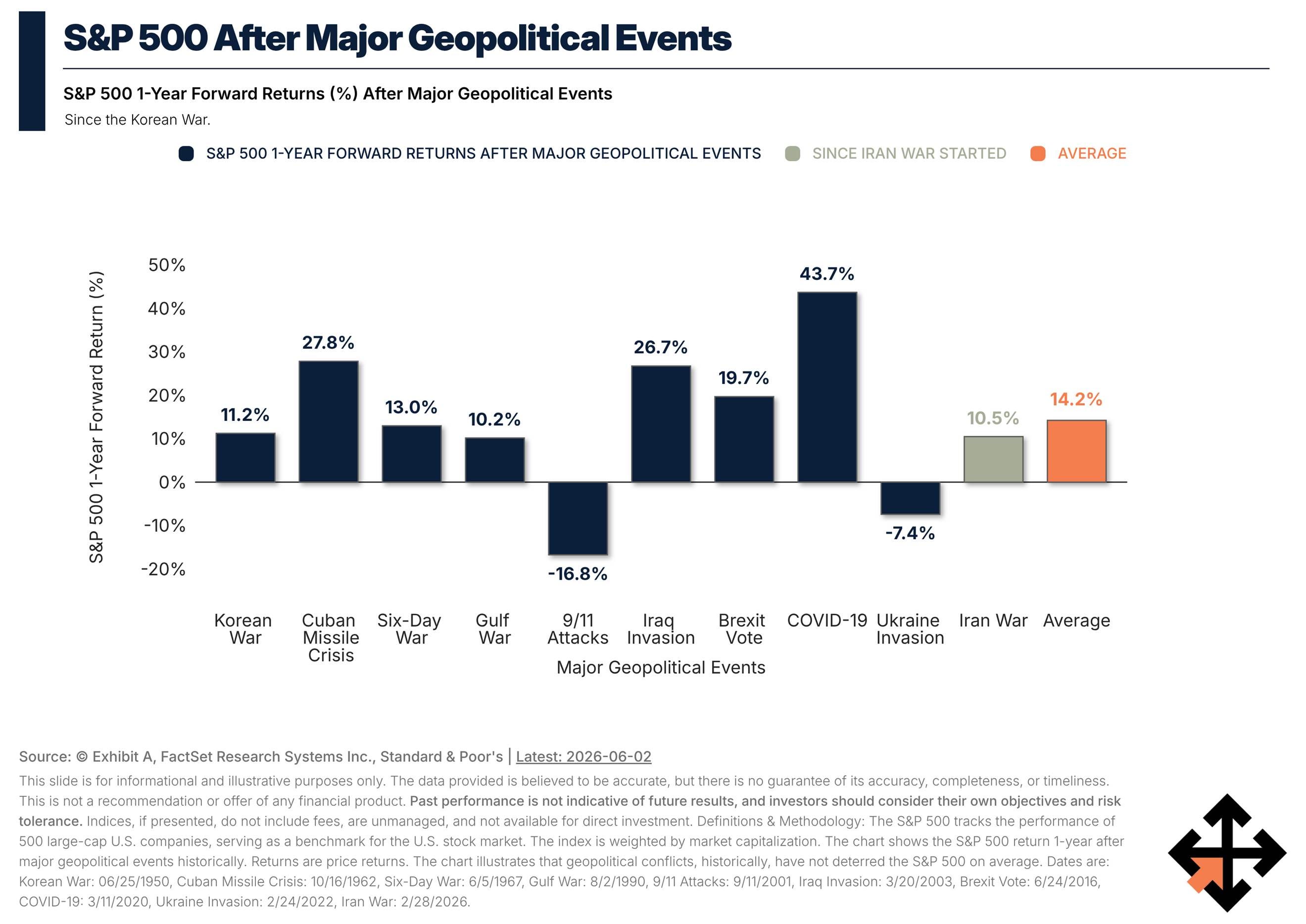
Long-term interest rates were on the up and up
One of the most significant developments in May was the volatility in interest rates.
The 30-year U.S. Treasury yield reached its highest level in nearly two decades during the month, before settling back below 5%. The 2-year and 10-year yields both rose as well, as expectations that interest rates would stay higher for longer grew.
The market now expects the Fed to hike rates once by the middle of 2027 in response to inflation concerns.
This is occurring because both the Consumer Price Index (CPI) and Producer Price Index (PPI) reports came in above expectations from higher energy prices. Rising inflation tends to push interest rates higher, since investors require more compensation if each dollar is worth less.
Higher interest rates matter because they affect all parts of the economy and markets, especially if they are the result of inflation. For consumers, there is a direct effect on the cost of borrowing including personal loans and mortgage rates. The same is true for businesses since it affects the cost of financing their operations.
When it comes to financial markets, higher rates mean that future cash flows are worth less today than they otherwise might be, affecting today’s asset prices.
At the same time, higher yields mean that bonds are now offering more meaningful income than they have in many years, which can support your bond holdings on a go forward basis.
Still, it’s important to maintain perspective on these moves. Markets have swung in both directions multiple times this year on changing expectations for a peace deal, and the situation continues to evolve.
I’d also note interest rates have also been impossibly difficult to predict over the past several years.
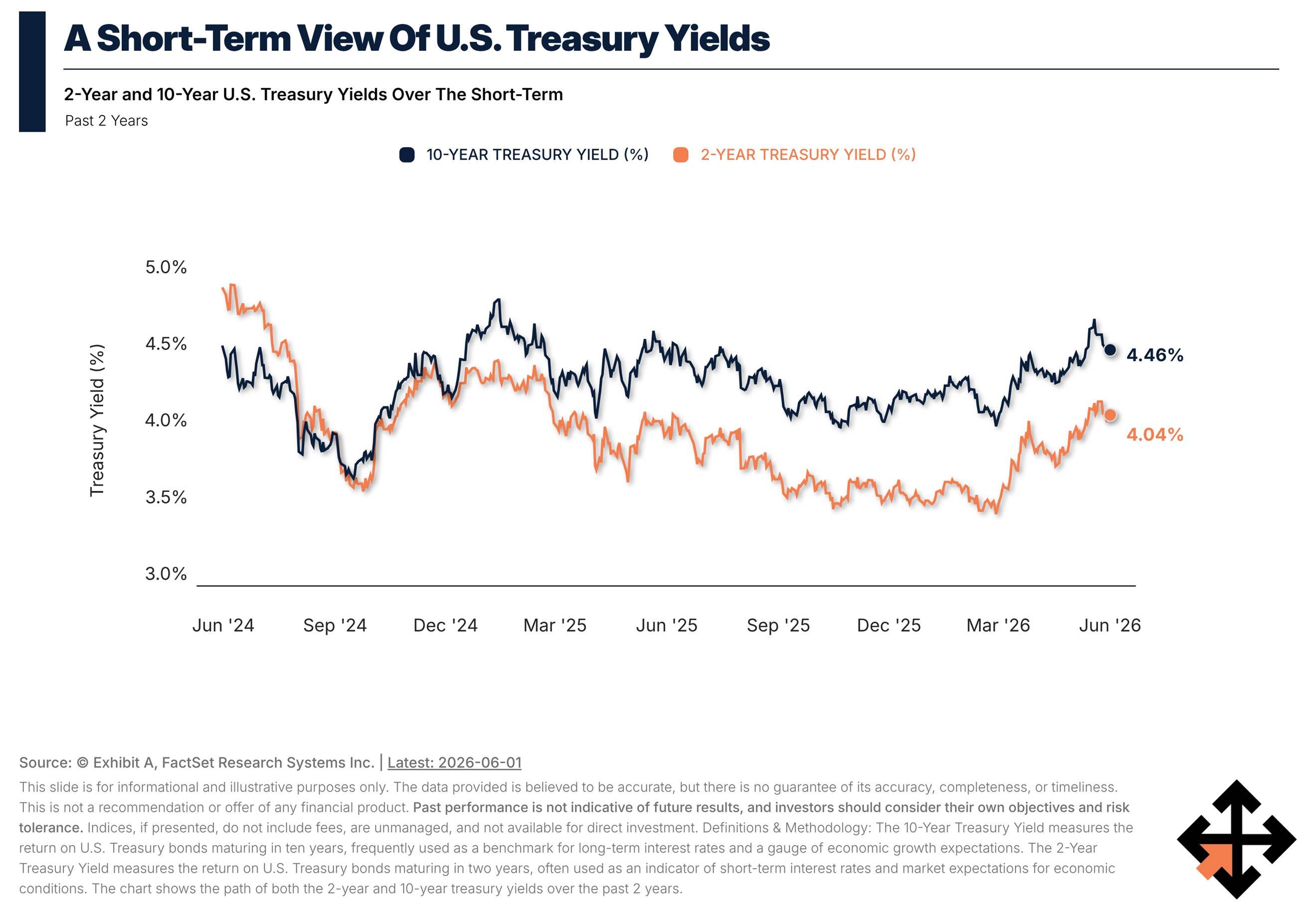
The stock market reached new heights
In spite of higher interest rates and headwinds to the bond market, the stock market continues to reach new all-time highs.
The S&P 500 surpassed 7,500 in May for the first time and there have been 22 all-time highs this year through the end of May. Tech stocks have powered the market higher over the last two months.
The fact that major indices reach new all-time highs is not unusual during a bull market. Historically, markets have trended upward over long periods of time, which means they often spend much of that time at or near record levels.
What matters more than the level of any single index is whether the underlying fundamentals remain healthy. And what we see there are corporate earnings that continue to grow at a healthy clip, with consensus estimates pointing to further growth in the coming year. Strong corporate earnings growth has helped keep valuations stable, even as the market has reached new heights.
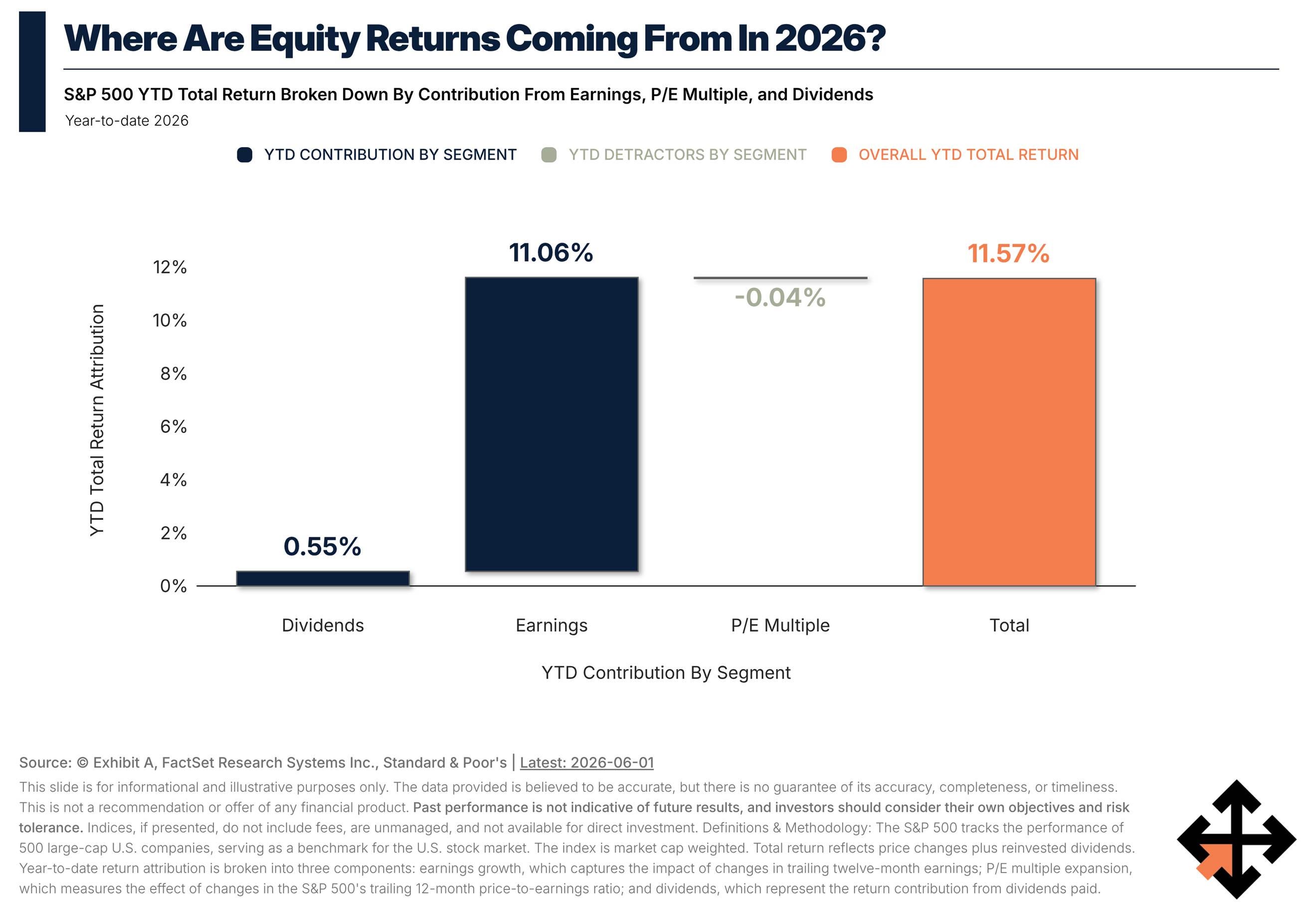
Kevin Warsh sworn in as the new Fed Chair
Kevin Warsh was officially sworn in as the new Chair of the Federal Reserve in May, succeeding former Chair Jerome Powell.
Warsh previously served on the Fed’s Board of Governors during the 2008 Global Financial Crisis and is viewed by markets as a known quantity with experience in monetary policy and financial markets.
Fed leadership transitions happen infrequently by design, so they naturally raise questions about the path of policy in the years ahead.
Warsh is seen as a reformer, which can raise more uncertainty as to how a Fed under his leadership will conduct monetary policy. In his recent Senate testimony, Warsh emphasized that monetary policy independence is essential and that policymakers must act in the nation’s interest.
He has also signaled a preference for a more focused central bank, with a preference for less public signaling and fewer policy measures.
Regardless of what reforms Warsh might bring to the Fed as an institution, it’s clear that policymakers face a challenging economic environment.
The overall economy is still healthy, but inflation has accelerated in recent months while the labor market has been a bit soft. This creates a difficult balancing act, and markets have now flipped from expecting further rate cuts to at least one rate hike.
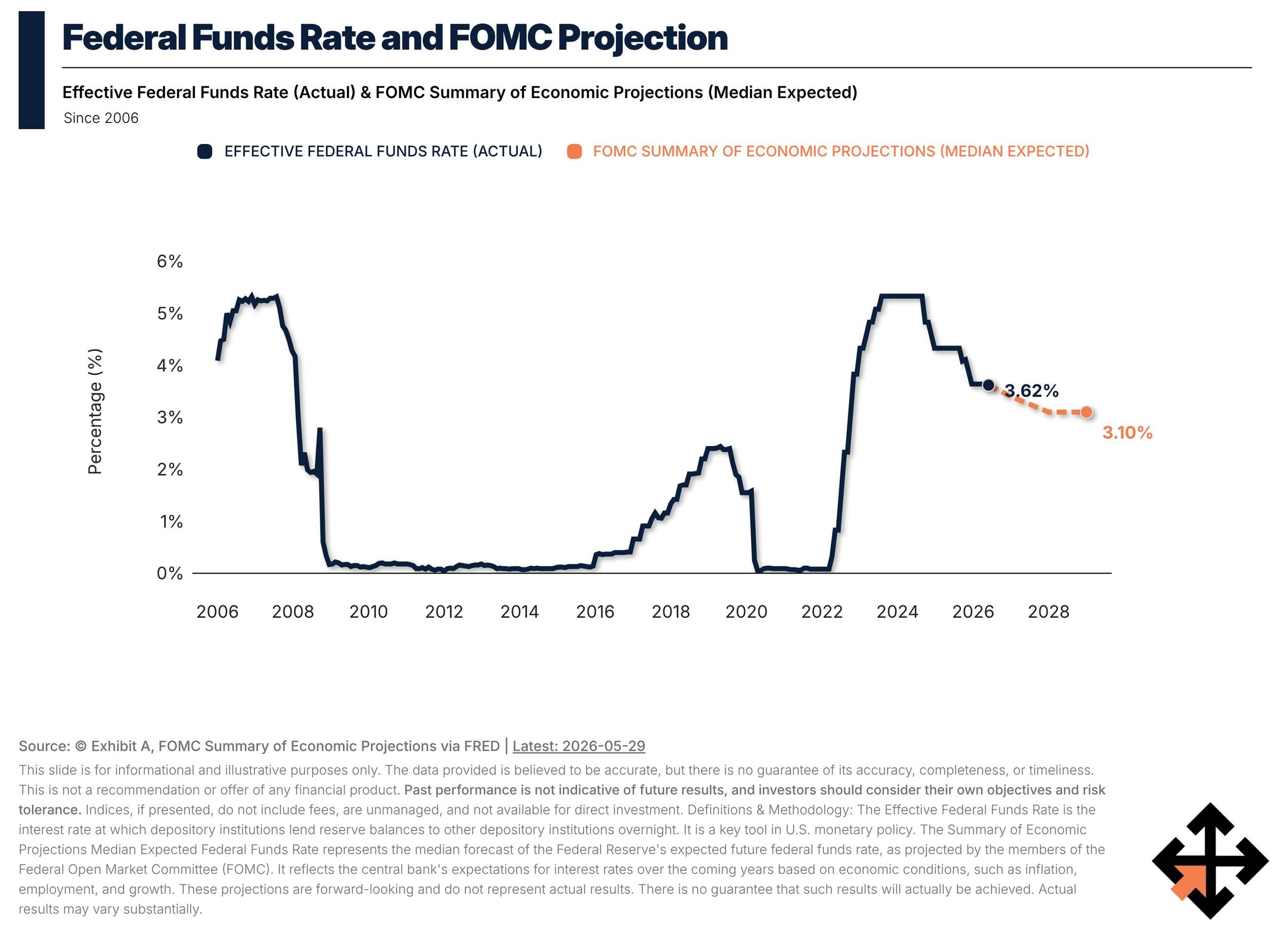
Bottom line
May brought new milestones for the stock market, extending a strong run for most investors.
While headlines around inflation, the new Fed Chair, and geopolitics will likely continue to generate uncertainty, the best approach for investors is still to focus on their executing their plan and staying the course.
Chart Source: Exhibit A
That’s all for today.
Blake
Questions about your financial goals or future?
Connect with a Sandbox financial advisor – our team is here to support you every step of the way!
Welcome to The Sandbox Daily, a daily curation of relevant research at the intersection of markets, economics, and lifestyle. We are committed to delivering high-quality and timely content to help investors make sense of capital markets.
Blake Millard is the Director of Investments at Sandbox Financial Partners, a Registered Investment Advisor. All opinions expressed here are solely his opinion and do not express or reflect the opinion of Sandbox Financial Partners. This Substack channel is for informational purposes only and should not be construed as investment advice. The information and opinions provided within should not be taken as specific advice on the merits of any investment decision by the reader. Investors should conduct their own due diligence regarding the prospects of any security discussed herein based on such investors’ own review of publicly available information. Clients of Sandbox Financial Partners may maintain positions in the markets, indexes, corporations, and/or securities discussed within The Sandbox Daily. Any projections, market outlooks, or estimates stated here are forward looking statements and are inherently unreliable; they are based upon certain assumptions and should not be construed to be indicative of the actual events that will occur.
Please see additional disclosures (click here)
Please see our SEC Registered firm brochure (click here)
Please see our SEC Registered Form CRS (click here)