


Welcome, Sandbox friends.
Today’s Daily discusses:
a new frontier under Kevin Warsh
Let’s dig in.
Blake
Markets in review
EQUITIES: Nasdaq 100 +2.48% | Russell 2000 +2.12% | S&P 500 +1.08% | Dow +0.14%
FIXED INCOME: Barclays Agg Bond +0.29% | High Yield +0.35% | 2yr UST 4.177% | 10yr UST 4.898%
COMMODITIES: Brent Crude -0.16% to $77.27/barrel. Gold -3.31% to $4,236.2/oz.
BITCOIN: -2.04% to $63,067
US DOLLAR INDEX: +0.70% to 100.79
CBOE TOTAL PUT/CALL RATIO: 0.86
VIX: -11.06% to 16.40
Quote of the day
“Peace is the result of retraining your mind to process life as it is, rather than as you think it should be.”
- Wayne W. Dyer
The Fed’s new approach under Kevin Warsh
There’s a new sheriff in town at the Federal Reserve and his name is Kevin Warsh.
Yesterday, the Fed voted unanimously to hold interest rates steady in the 3.50%-3.75% range, exactly as expected. But, rates may not stay unchanged for long. Even though Warsh was nominated by President Trump with an expectation he’d quickly lower interest rates, the central bank signaled that rates might actually go higher this year; 9 of 19 officials projected a rate hike coming this year after none did so in March.
Of much greater significance, Kevin Warsh’s first Fed meeting wasn’t even about changing interest rates. It was about changing the role of the Federal Reserve itself.
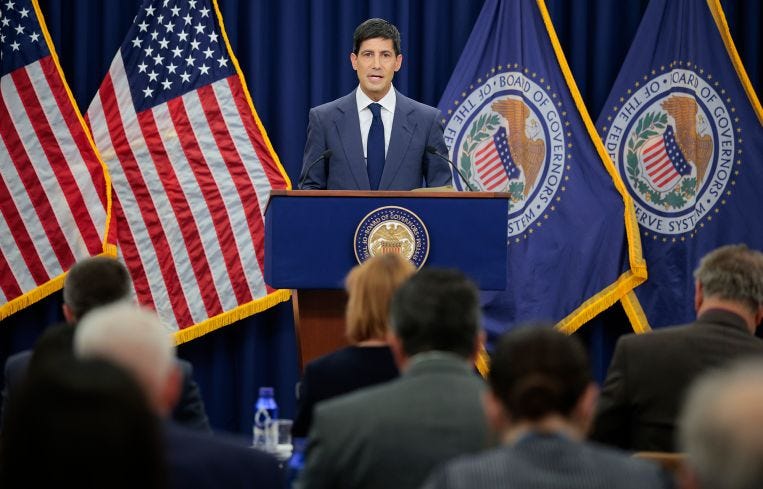
Warsh’s Q&A discussion was a forum to send a much bigger message: focus on inflation, stop trying to handhold markets, and rethink assumptions that have defined central banking since the Global Financial Crisis.
Here are 10 things that stood out to me:
• This wasn’t even about interest rates. Nobody expected the Fed to cut or hike rates yesterday. The real story was the unveiling of Warsh’s vision for the institution itself. Nearly every major signal coming out of the meeting pointed toward a different approach to communications, policymaking, and the central bank’s tools.
• The Fed is talking less. The post-meeting statement was the shortest in decades and resembled the brief communications common during the Alan Greenspan era. Investors have become accustomed to increasingly detailed explanations. Warsh appears to be moving in the opposite direction. The statement was just 130 words, a massive cut from the 341 words in the final Powell-led Fed meeting on April 29. See the graphic at the bottom.
• Credibility over predictability. This may be the most important takeaway from the entire meeting. For years, the Fed tried to reduce uncertainty by telling markets what it expected to do next. Warsh seems to believe the Fed’s credibility comes from delivering low inflation, not from making markets comfortable. He appears willing to tolerate more uncertainty if it helps restore confidence in the Fed’s inflation-fighting commitment.
• The era of forward guidance is likely ending. Warsh has openly criticized the Fed’s habit of signaling future rate moves. He has argued that excessive guidance can constrain policymakers and encourage markets to focus on Fed forecasts instead of actual economic conditions.
• Fed watching just got harder. Investors have spent years dissecting speeches, statements, forecasts, and press conferences for clues. If Warsh follows through on his philosophy, there may simply be fewer clues available. Markets may have to rely more on incoming data and less on Fed messaging.
• Warsh is conducting a top-to-bottom review of the institution. He immediately launched five task forces examining communications, inflation frameworks, data sources, productivity, and the Fed’s balance sheet. Most Fed chairs inherit the institution they are given. Warsh appears determined to evaluate whether the institution itself needs reform. The savvy veteran Keith Fitz-Gerald had this to say: “The tools it uses are antiquated and don’t reflect modern economics.”
• The Fed’s footprint in markets may shrink over time. One of those task forces will examine the Fed’s massive balance sheet, which expanded dramatically after the financial crisis and pandemic. While this won’t happen overnight, Warsh has long questioned whether the central bank has become too involved in financial markets.
• The most important dot was the missing one. Warsh declined to submit his own rate projection to the Fed’s famous dot plot, as 18 of 19 Fed policymakers submitted projections. That may sound insignificant, but it was a direct signal that he may not believe the Fed should be providing investors with a roadmap for future policy decisions.
• Inflation is back at the center of the Fed’s mission. The defining quote of Kevin’s inaugural press conference was simple: “This committee will deliver price stability.” Warsh rarely emphasized employment and repeatedly returned to inflation on about a dozen occasions. The message was clear: the 2% inflation target is not being reconsidered and remains the central bank’s “North Star.”
• Nothing changed and everything changed. Interest rates stayed exactly where they were. But the framework investors use to think about the Federal Reserve may have shifted meaningfully. Under Powell, the Fed often tried to tell markets what it was going to do. Under Warsh, the Fed may simply do it.
As strategist Dario Perkins put it after the meeting: “Fed watching just got harder.”
That may be exactly what Kevin Warsh intends.
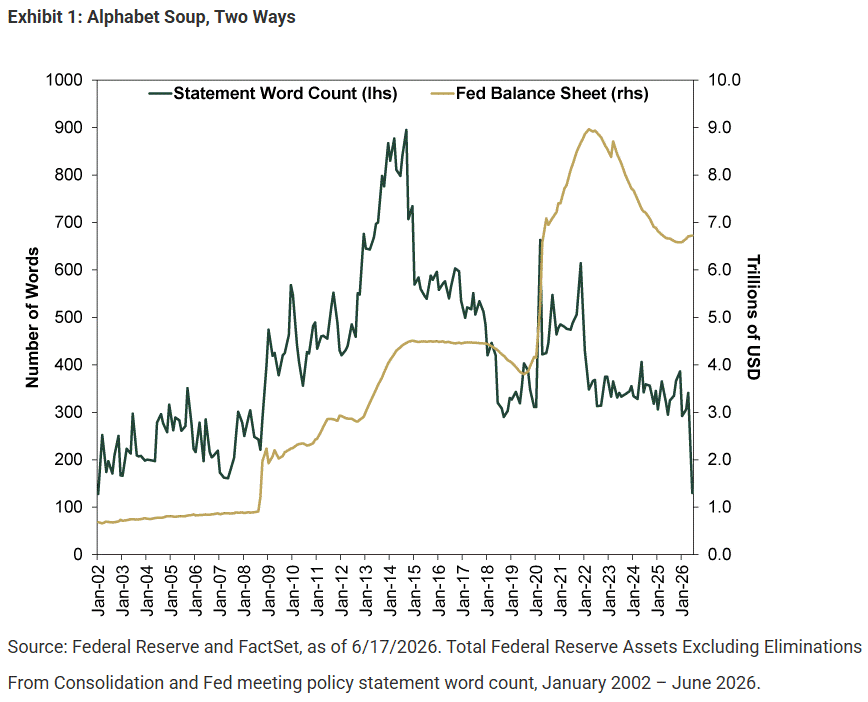
Chart source: Fisher Investments
That’s all for today.
Blake
Questions about your financial goals or future?
Connect with a Sandbox financial advisor – our team is here to support you every step of the way!
Welcome to The Sandbox Daily, a daily curation of relevant research at the intersection of markets, economics, and lifestyle. We are committed to delivering high-quality and timely content to help investors make sense of capital markets.
Blake Millard is the Director of Investments at Sandbox Financial Partners, a Registered Investment Advisor. All opinions expressed here are solely his opinion and do not express or reflect the opinion of Sandbox Financial Partners. This Substack channel is for informational purposes only and should not be construed as investment advice. The information and opinions provided within should not be taken as specific advice on the merits of any investment decision by the reader. Investors should conduct their own due diligence regarding the prospects of any security discussed herein based on such investors’ own review of publicly available information. Clients of Sandbox Financial Partners may maintain positions in the markets, indexes, corporations, and/or securities discussed within The Sandbox Daily. Any projections, market outlooks, or estimates stated here are forward looking statements and are inherently unreliable; they are based upon certain assumptions and should not be construed to be indicative of the actual events that will occur.
Please see additional disclosures (click here)
Please see our SEC Registered firm brochure (click here)
Please see our SEC Registered Form CRS (click here)