


Welcome, Sandbox friends.
Today’s Daily discusses:
the war in the middle east, gasoline prices, and OPEC
Let’s dig in.
Blake
Markets in review
EQUITIES: Dow +0.11% | S&P 500 -0.16% | Nasdaq 100 -0.71% | Russell 2000 -0.97%
FIXED INCOME: Barclays Agg Bond -0.29% | High Yield -0.14% | 2yr UST 3.994% | 10yr UST 4.463%
COMMODITIES: Brent Crude +3.16% to $107.51/barrel. Gold -0.15% to $4,721.5/oz.
BITCOIN: -1.44% to $80,682
US DOLLAR INDEX: +0.36% to 98.31
CBOE TOTAL PUT/CALL RATIO: 0.74
VIX: -2.12% to 17.99
Quote of the day
“We won’t be distracted by comparison if we’re captivated with purpose.”
- Bob Goff
The war in the middle east, gasoline prices, and OPEC
The most visible way the conflict in Iran has reached American households is through the price at the pump.
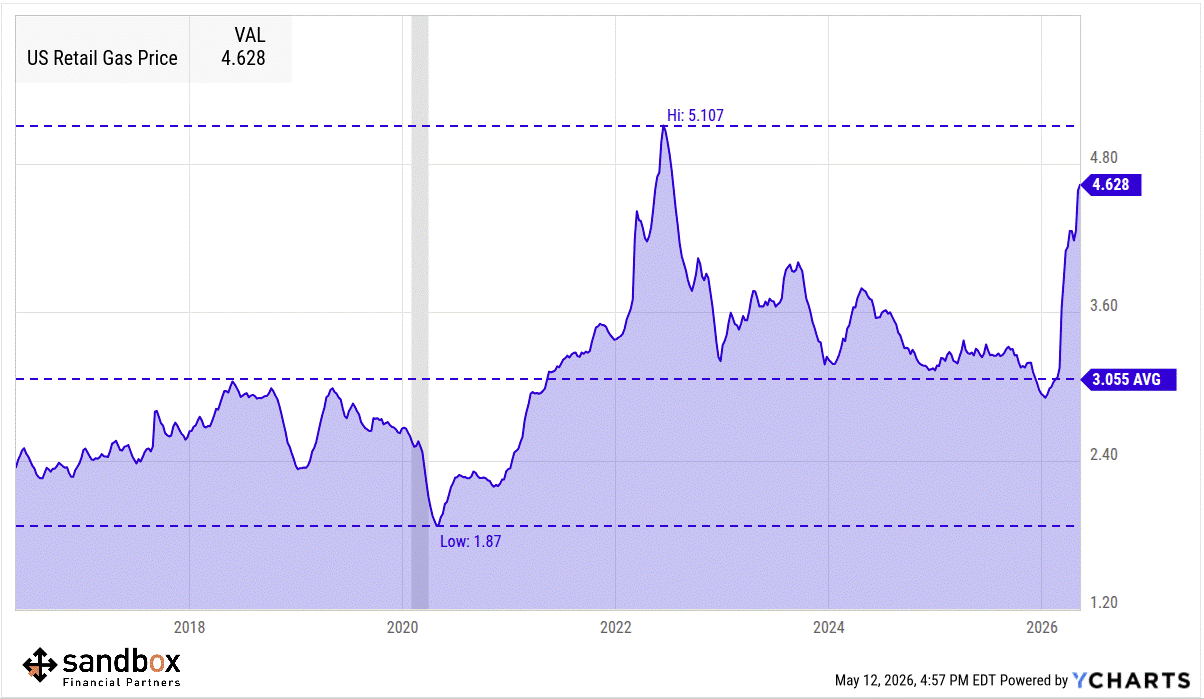
The national average for gasoline has climbed to roughly $4.50 per gallon, well above the $3.05 average price paid over the last 10 years and a meaningful jump from levels seen just a few months ago.
In some parts of the country, gasoline is already above $6 per gallon.
And, because energy costs directly impact various components across the Consumer Price Index (CPI), headline inflation has moved higher – complicating an economic picture that was previously improving from 2025’s high levels of economic and political uncertainty and volatility.
For the older folks, this environment may bring back memories of the 1970s Arab Oil Embargo, when oil supply shocks led to skyrocketing inflation and gasoline rationing.
Fortunately, the world has changed considerably since then.
1st, the United States is now the largest energy producer in the world, pumping more than 13 million barrels of oil per day. This has helped to reduce the sensitivity of the U.S. economy to global oil disruptions.
2nd, the recent decision by the United Arab Emirates (UAE) to exit OPEC is another reminder of how the global energy landscape is constantly changing.
For decades, OPEC members played a central role in setting global oil prices. This was primarily done by agreeing on production levels, which to be fair, is difficult to achieve and verify across a dozen countries. Specifically, it is difficult to prevent OPEC member countries from producing more than their agreed-upon limits.
The UAE’s recently announced departure shows how the cartel is not as relevant as it once was, as member countries pursue their own national strategies and production capacities.
At its peak in the 1970s, OPEC accounted for at least half of the world’s oil supply. Today, it is closer to one-third.
With the UAE’s departure, estimates should drive OPEC’s share of global crude production below 30%.
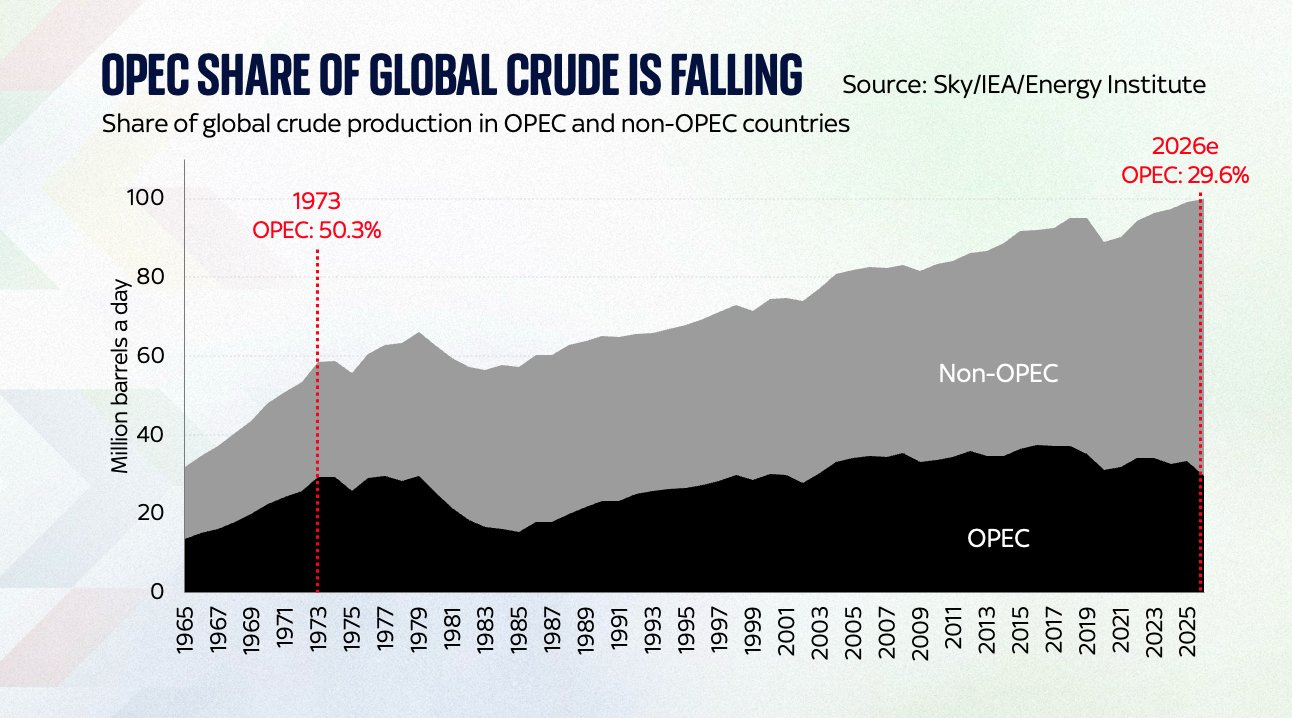
To offset this, a broader group known as OPEC+, which includes Russia and other countries, was formed, but the same coordination challenges apply.
The declining relevance of OPEC doesn’t eliminate the risk of oil price shocks during geopolitical events, but it does mean that oil prices are not quite as sensitive to their decisions as in the past.
While this provides little comfort to households whose budgets are directly impacted by higher gasoline prices, it does help to explain why the effect on markets hasn’t been more dramatic in 2026.
Sources: YCharts, International Energy Agency
That’s all for today.
Blake
Questions about your financial goals or future?
Connect with a Sandbox financial advisor – our team is here to support you every step of the way!
Welcome to The Sandbox Daily, a daily curation of relevant research at the intersection of markets, economics, and lifestyle. We are committed to delivering high-quality and timely content to help investors make sense of capital markets.
Blake Millard is the Director of Investments at Sandbox Financial Partners, a Registered Investment Advisor. All opinions expressed here are solely his opinion and do not express or reflect the opinion of Sandbox Financial Partners. This Substack channel is for informational purposes only and should not be construed as investment advice. The information and opinions provided within should not be taken as specific advice on the merits of any investment decision by the reader. Investors should conduct their own due diligence regarding the prospects of any security discussed herein based on such investors’ own review of publicly available information. Clients of Sandbox Financial Partners may maintain positions in the markets, indexes, corporations, and/or securities discussed within The Sandbox Daily. Any projections, market outlooks, or estimates stated here are forward looking statements and are inherently unreliable; they are based upon certain assumptions and should not be construed to be indicative of the actual events that will occur.
Please see additional disclosures (click here)
Please see our SEC Registered firm brochure (click here)
Please see our SEC Registered Form CRS (click here)