


Welcome, Sandbox friends.
Today’s Daily discusses:
affordability takes center stage
Let’s dig in.
Blake
Markets in review
EQUITIES: Russell 2000 +0.52% | Dow +0.03% | S&P 500 -0.54% | Nasdaq 100 -1.16%
FIXED INCOME: Barclays Agg Bond +0.16% | High Yield -0.09% | 2yr UST 3.434% | 10yr UST 4.008%
COMMODITIES: Brent Crude +0.59% to $70.67/barrel. Gold -0.19% to $5,216.5/oz.
BITCOIN: -2.47% to $67,368
US DOLLAR INDEX: +0.07% to 97.76
CBOE TOTAL PUT/CALL RATIO: 0.85
VIX: +3.90% to 18.63
Quote of the day
“People will forget what you said, people will forget what you did, but people will never forget how you made them feel.”
- Maya Angelou
Affordability takes center stage
Given poor consumer sentiment and fears around a “K-shaped” economy, the current administration has been laser focused on announcing new policies aimed at increasing affordability.
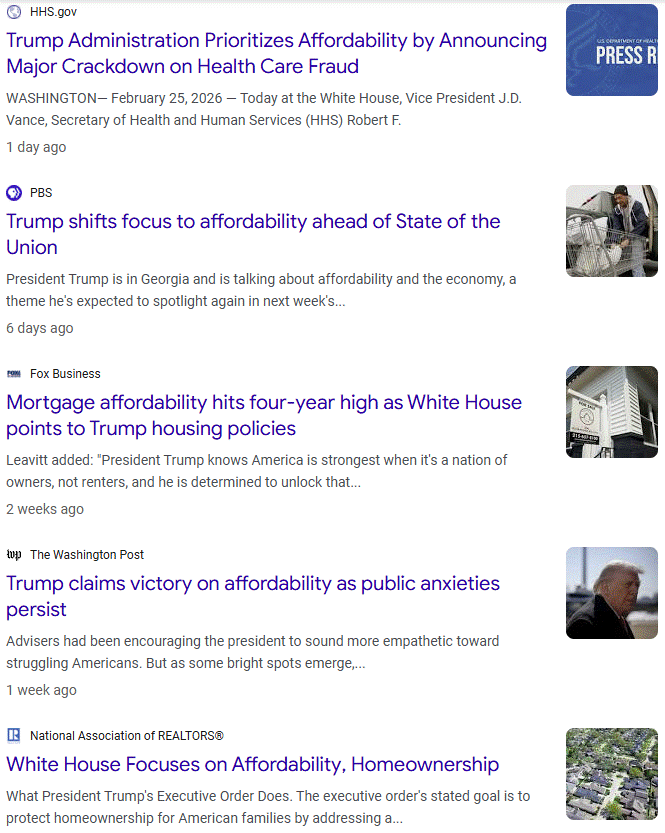
The blitz of proposals to improve affordability began mid-last year with the passage of the One Big Beautiful Bill Act and the promise of tax relief for American families.
Meanwhile, the start of 2026 has been marked by a series of policy announcements intended to improve affordability for U.S. consumers: 10% credit card interest rate cap, “Most Favored Nation” prescription drug pricing, housing market reforms, and many others.
Amidst all these changes, though, the earliest and most profound changes were the tax cuts for the consumer through the One Big Beautiful Bill Act.
While the tax cuts were implemented retroactively for 2025, tax withholding rates were not adjusted. Hence, this drives a higher-than-average tax refund this year.
January 26th marked the official start of the 2026 tax filing season.
Recently, the Treasury published a factsheet estimating a sharp increase in the average tax refunds for a significant share of families across the United States.
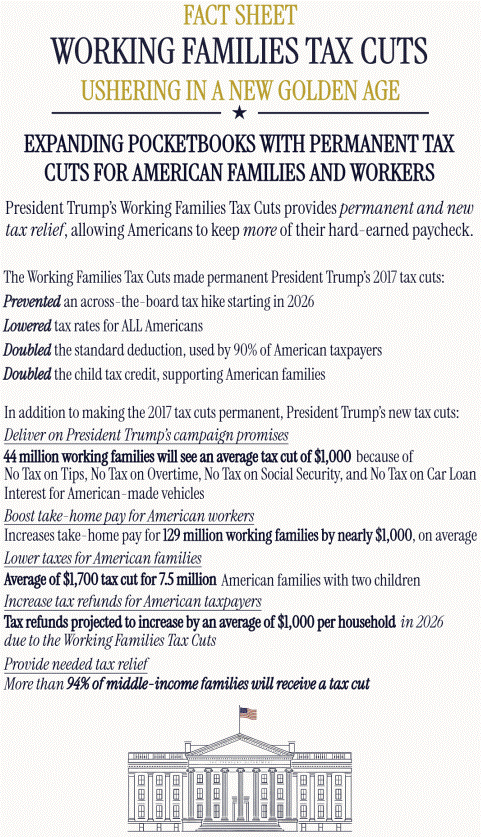
The Treasury has estimated that households will benefit from a $1,000 increase in their average tax refund this year, an approximate 31% increase in refunds, from the average refund last year ($3,230).
The rise in refunds is likely to offset higher consumer costs and decrease credit obligations/delinquencies to a more significant extent than traditional patterns, thus injecting a fiscal impulse across the economy in a meaningful way across 1H26.
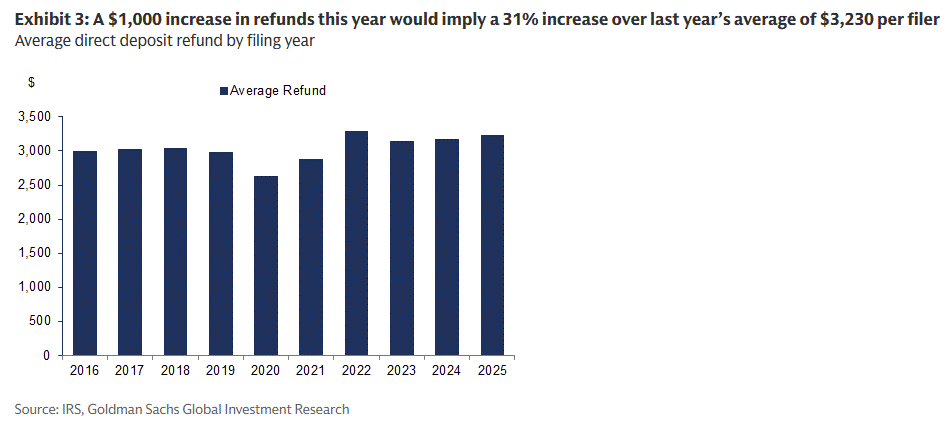
Sources: U.S. Department of Treasury, Bloomberg, Goldman Sachs Global Investment Research
That’s all for today.
Blake
Questions about your financial goals or future?
Connect with a Sandbox financial advisor – our team is here to support you every step of the way!
Welcome to The Sandbox Daily, a daily curation of relevant research at the intersection of markets, economics, and lifestyle. We are committed to delivering high-quality and timely content to help investors make sense of capital markets.
Blake Millard is the Director of Investments at Sandbox Financial Partners, a Registered Investment Advisor. All opinions expressed here are solely his opinion and do not express or reflect the opinion of Sandbox Financial Partners. This Substack channel is for informational purposes only and should not be construed as investment advice. The information and opinions provided within should not be taken as specific advice on the merits of any investment decision by the reader. Investors should conduct their own due diligence regarding the prospects of any security discussed herein based on such investors’ own review of publicly available information. Clients of Sandbox Financial Partners may maintain positions in the markets, indexes, corporations, and/or securities discussed within The Sandbox Daily. Any projections, market outlooks, or estimates stated here are forward looking statements and are inherently unreliable; they are based upon certain assumptions and should not be construed to be indicative of the actual events that will occur.
Please see additional disclosures (click here)
Please see our SEC Registered firm brochure (click here)
Please see our SEC Registered Form CRS (click here)